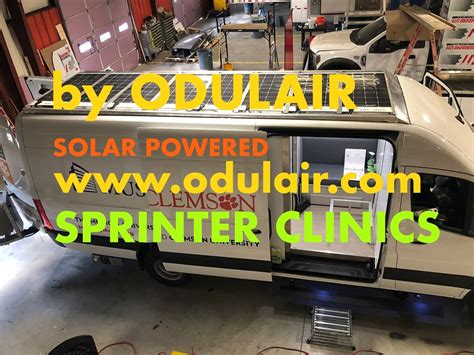
Any mobile health van or any mobile health clinic will greatly benefit from being a solar-powered van. Here are four things to consider and compare when choosing between solar and the old-fashioned way of using a generator to power the daily operations of your mobile health clinic.


Solar Power Pros and Cons
While the initial investment in a solar-powered van as a mobile clinic is bigger than the old-fashioned generator, the difference in investment will pay itself out quickly and several times over the course of just a few years (the more use you use it, the faster it pays itself off). That means more money in your pocket.
Then, your investment will produce immediate results that you’ll truly appreciate and that money will never begin to cover. The upgrade to a solar-powered solution in a sprinter can provide superior quietness inside the clinic and no vibration and no smells.
If you have ever experienced working close to a generator for eight hours a day, you will know and appreciate the upgrade. Remember the three NOs: no noise, no fumes, no vibration. Truly priceless.
1. Solar vs. Generator
Solar panels require no dedicated maintenance to work effectively and will remain a reliable power source for many years of use. Now, let’s compare the ease and simplicity of solar panels with the “to-do list” that comes with a generator. Anybody who depends on a generator to power eight hours of daily operations will need periodic preventive maintenance to make sure the generator will work when you need it.
Full disclosure: a gas or diesel generator turns out to be everything but a “set it and forget it” type of device. In fact, it’s an attention-craving machine. Whoever will be in charge of taking care of the generator maintenance will have a laundry list of items to contend with weekly, monthly, and annually. Regular maintenance will be crucial to avoid breakdowns and prolong the generator’s life. Without preventive maintenance, generators are guaranteed to have problems, which eventually will cause breakdowns or, worse, critical damage to the generator itself.
The oil of a generator must be changed after 100 hours of use, even sooner when it’s the first time that it will be changed. It is recommended the first oil change be performed right after the first 30 hours of use. Also, the plugs and the air filter need to be switched out every 200 hours. If you don’t use the generator often, the fuel should be drained.
On a weekly basis, here’s the typical rundown of maintenance tasks a generator requires:
- Clean the generator
- Clean its surrounding area
- Check the engine coolant levels
- Check the battery charger
- Check the engine oil levels
On a yearly basis, this is what will have to be done to maintain a generator properly:
- Change the oil
- Change the oil filter, fuel filter, and air filter
- Flush the cooling system
- Inspect the wiring/electrical system
- Change the spark plugs
- Test the transfer switch
2. Solar Powered Van is Better
Now, let’s compare powering a mobile clinic with solar energy versus powering it with a generator. You’ll realize that the only thing you occasionally may have to do with your solar panels is clean them intermittently to ensure maximum output.
Last but not least, fuel isn’t cheap, nor free, while the sun still is.
Less maintenance means less time wasted, fewer labor hours, and fewer costs.
And anytime you don’t have to contend with a fuel generator, that represents bigger savings and more money in your pocket.
3. Solar Energy is Clean Energy
Solar power is a sustainable, clean, renewable energy. In practice, the positive impact it will have on your mobile health clinic or mobile health center operations goes beyond that: it means no pollution, no fumes, no noise, and no exhausting vibrations for your staff and patients. And because your daily operations will run from the harvested solar energy, it also means more money in your pocket. Truly priceless.
4. Lifespan
Solar panels are durable and rugged, and they are built to withstand decades of any and all weather conditions, even large-sized hail. The life expectancy of solar panels is 25 to 30 years. After their life expectancy, solar panels won’t drop dead and stop producing electricity overnight, but they’ll slowly fade out from their original peak efficiency standards. Most likely, the solar panels in the mobile clinic will outlast the lifespan of the mobile health van as a vehicle itself.
Ready to Specify Your Van?
Our engineering team responds within one business day. All van platforms: 50-day lead time. WOSB set-aside eligible.